
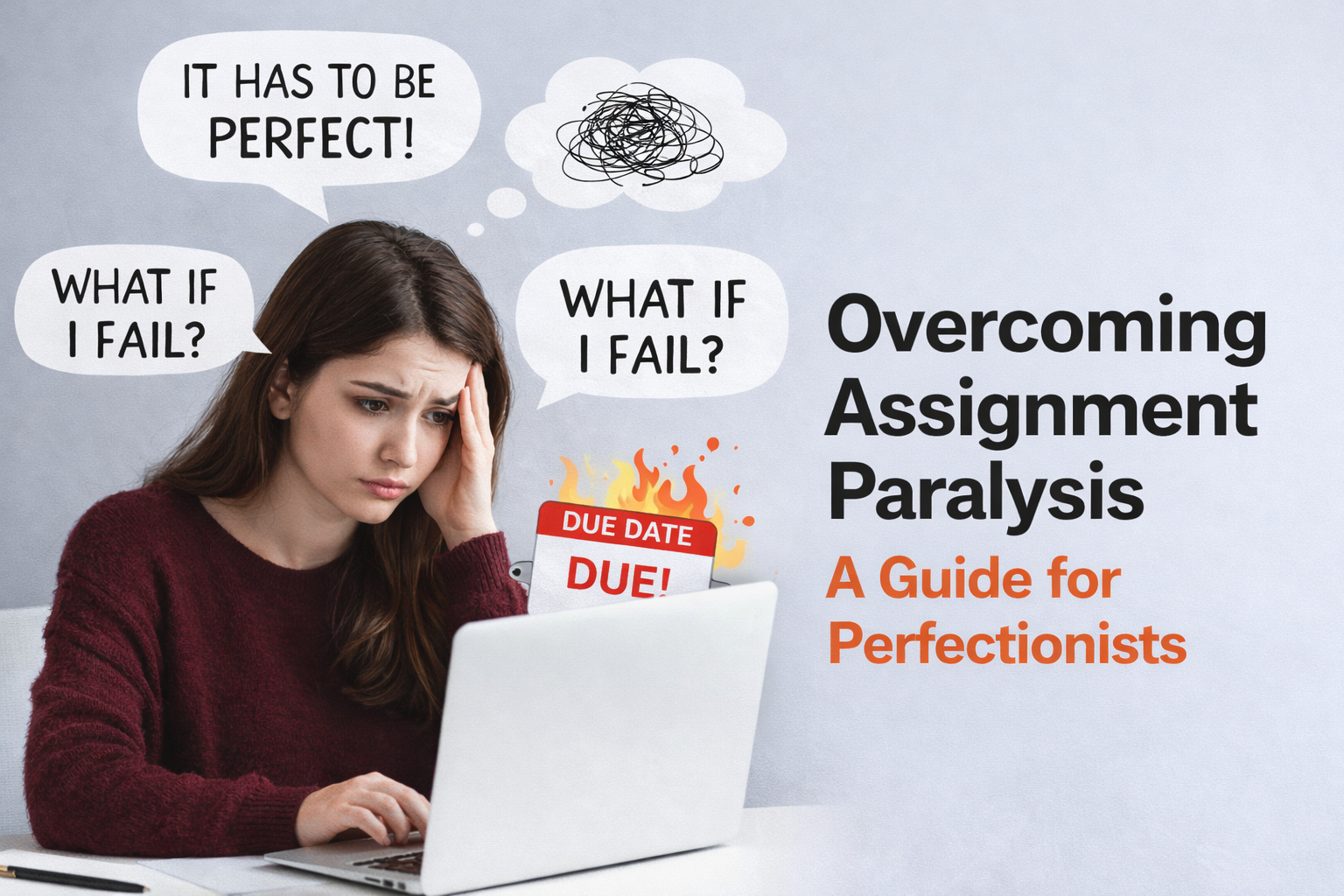
You Are Not Lazy. You Are Stuck.
It is 11 p.m. Your assignment is due in three days. You have opened your laptop more times than you can count. You have read the instructions. You have checked the rubric. You might have even named the document.
And yet, nothing is written.
If you are sitting there wondering why you cannot start your assignment even though you know you should, I want you to hear this first. You are not lazy. You are not stupid. You are not failing at being a student.
What you are experiencing is assignment paralysis.
Assignment paralysis is incredibly common, especially among students who care deeply about doing well. Research shows that up to 95 percent of students procrastinate at some point, and around one in five struggle with perfectionism. When pressure, fear, and high expectations collide, your brain freezes instead of moving forward.
By the end of this guide, you will understand exactly why this happens and what you can do today to get unstuck.
What Assignment Paralysis Actually Feels Like
Assignment paralysis is not just putting things off. It is the feeling of being mentally blocked even when you want to work and even when you have time.
You might be staring at a blank page for hours, telling yourself you will start once you feel ready. You might keep researching without writing a single sentence. You might jump between tabs, tasks, and apps while feeling more anxious by the minute.
You may keep asking yourself questions like why can’t I start my assignments or what is wrong with me. Nothing is wrong with you. Your nervous system is overwhelmed.
Unlike normal procrastination, assignment paralysis is driven by emotions, not poor planning. Fear, self-criticism, and academic anxiety take over, making starting feel dangerous rather than productive.
If any of this feels familiar, you are not imagining it.
Why Your Brain Freezes When You Try to Start
Understanding the psychology behind assignment paralysis is the key to overcoming it. This is not a motivation problem. It is a protective response.
Perfectionism Is Running the Show
If you have perfectionist tendencies, starting an assignment feels risky. Your brain tells you that the work must be excellent from the very first sentence. Anything less feels like failure.
You may think, if I cannot write an A-level introduction, I should not start at all. This all-or-nothing thinking keeps you stuck because perfection feels impossible.
Ironically, perfectionism is strongly linked to academic procrastination and lower performance, not better results.
Fear of Failure Is Louder Than You Realize
In college, grades often feel tied to your future, your family’s expectations, or your sense of self-worth. When an assignment feels like a judgment of who you are, starting becomes terrifying.
Your brain chooses avoidance because not starting feels safer than trying and failing. This is why fear of failure in college so often leads to academic paralysis.
Overwhelm Creates Mental Blocks
Sometimes the assignment just feels too big. You do not know where to begin. There are too many instructions, too many sources, or too many deadlines at once.
When your brain cannot identify a clear first step, it shuts down. This is why you may feel busy all day but make no progress.
Past Experiences Still Affect You
If you have been harshly graded before or criticized for your writing, your brain remembers. When a new assignment appears, it triggers those memories and the fear comes back instantly.
Avoidance becomes a way to protect yourself from feeling that disappointment again.
Mental Health Can Make Starting Harder
Anxiety, depression, ADHD, burnout, and stress all affect your ability to initiate tasks. This is not a character flaw. It is how the brain responds under pressure.
Struggling to start does not mean you are incapable. It means you need compassion and support.
How to Get Unstuck With Homework When You Feel Frozen
Let’s talk about what actually helps. These strategies are designed for overthinkers, perfectionists, and anxious students. You do not need to use all of them. Pick one and try it today.
Give Yourself Permission to Write Badly
Your first draft is not supposed to be good. It is supposed to exist.
Set a ten-minute timer and write whatever comes to mind. Grammar does not matter. Structure does not matter. You can fix messy writing, but you cannot fix a blank page.
Progress always comes before perfection.
Break the Assignment Into Tiny Pieces
Do not think about finishing the assignment. Think about opening the document. Then think about writing one sentence.
Small actions reduce anxiety and create momentum. Each completed micro task gives your brain a sense of progress and control.
Change Where You Work
Your environment affects your mindset more than you realize. Try working in a library, a café, or with other students around you.
When your environment signals focus, starting becomes easier.
Accept That Good Enough Is Enough
Ask yourself what level of effort is required to pass or do reasonably well. Most assignments do not require perfection to earn solid grades.
The fear of doing badly is usually far worse than the actual outcome.
Externalize the Pressure
Tell someone what you plan to work on today. Study with a friend. Use accountability tools or body doubling sessions.
When someone else is involved, it becomes easier to start.
Address the Fear Directly
Instead of avoiding the anxiety, write it down. Ask yourself what you are actually afraid of. Is it making mistakes? Is it being judged? Is it failing?
Once the fear is named, it loses some of its power.
Use Clear If Then Plans
Decide in advance what you will do and when. For example, when it is 4 p.m., I will write for fifteen minutes.
This removes the mental effort of deciding and makes action more automatic.
Remove Perfectionist Triggers
Stop rereading while drafting. Turn off spell check. Limit research time. Use a simple font.
These small changes reduce pressure and help you move forward.
Get Help When You Need It
Sometimes, you cannot do this alone. That does not mean you failed. It means you are human.
If you are stuck despite trying these strategies, external academic support can help you break through the mental block and regain momentum.
When You Might Need Extra Support
If multiple assignments are piling up, if anxiety is overwhelming, or if life responsibilities are making school unmanageable, getting help is a smart decision.
Academic support is not about cheating. It is about guidance, structure, and understanding the psychology behind academic stress.
If you are experiencing assignment paralysis and need help getting unstuck, our team specializes in supporting students through these exact challenges in a judgment-free and confidential way.
Long-Term Ways to Reduce Assignment Paralysis
Over time, therapy or counseling can help address perfectionism and fear of failure. Academic coaching can help with time management and planning. Mindfulness and stress management techniques can reduce academic anxiety.
You can also use campus writing centers and communicate with professors when you are struggling. You are allowed to ask for help.
You Are Not Broken
Assignment paralysis does not mean you are incapable. It means you care and you are under pressure.
You do not need to fix everything today. Start with one small step. Write one imperfect sentence.
If you need immediate support breaking through assignment paralysis, we are here for you.